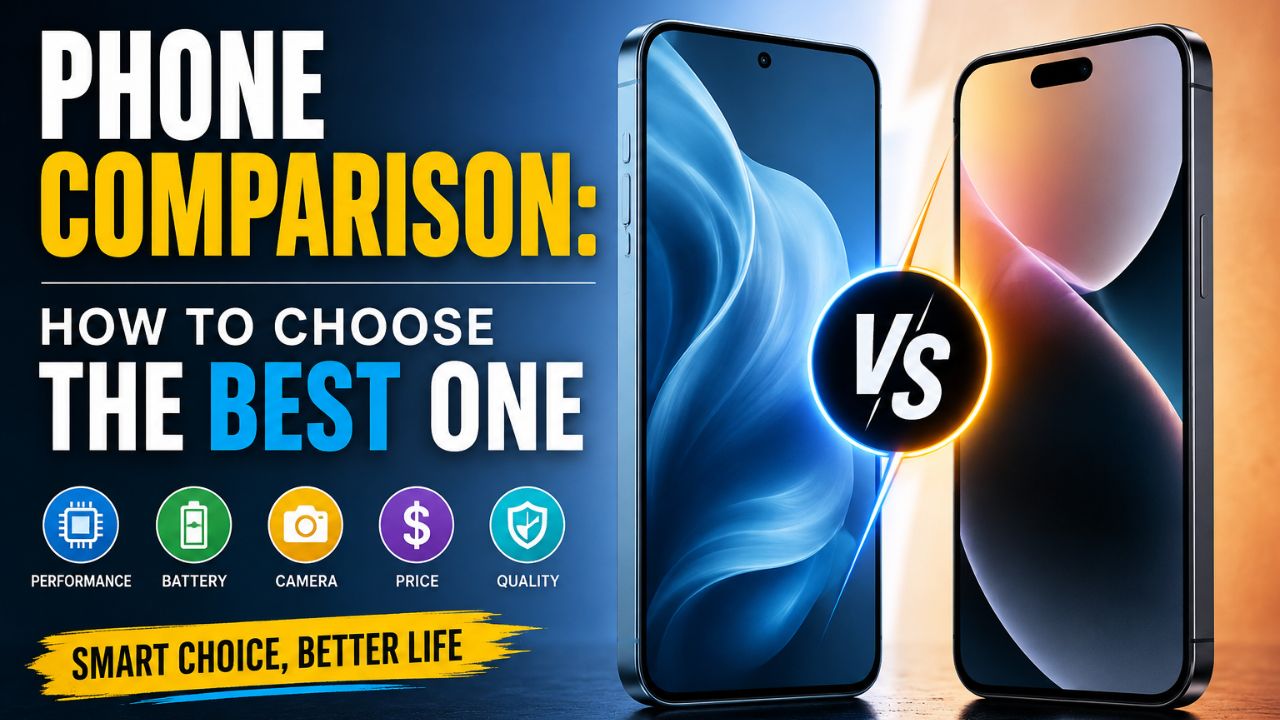
Buying a new phone sounds simple until you start comparing models. One phone has a faster chip, another has a bigger battery, a third promises better cameras, and a fourth looks like the “best deal” until you notice weaker software support or slower charging. That is why a proper phone comparison matters.
For most buyers, the goal is not finding the most expensive phone. It is finding the phone that gives you the right mix of performance, camera quality, battery life, display, software experience, and price for your daily use. Whether you are a gamer, a casual user, a student, a creator, or someone upgrading after three or four years, the smartest choice comes from comparing phones in a structured way.
At Phoneranker, we believe smartphone buying should feel clear, not confusing. Accurate specs, honest comparisons, simple explanations, and practical value judgments help readers make confident decisions without getting lost in marketing language.
Contents
- 1 Why Phone Comparison Matters More Than Ever
- 2 Start With Your Own Usage, Not the Marketing
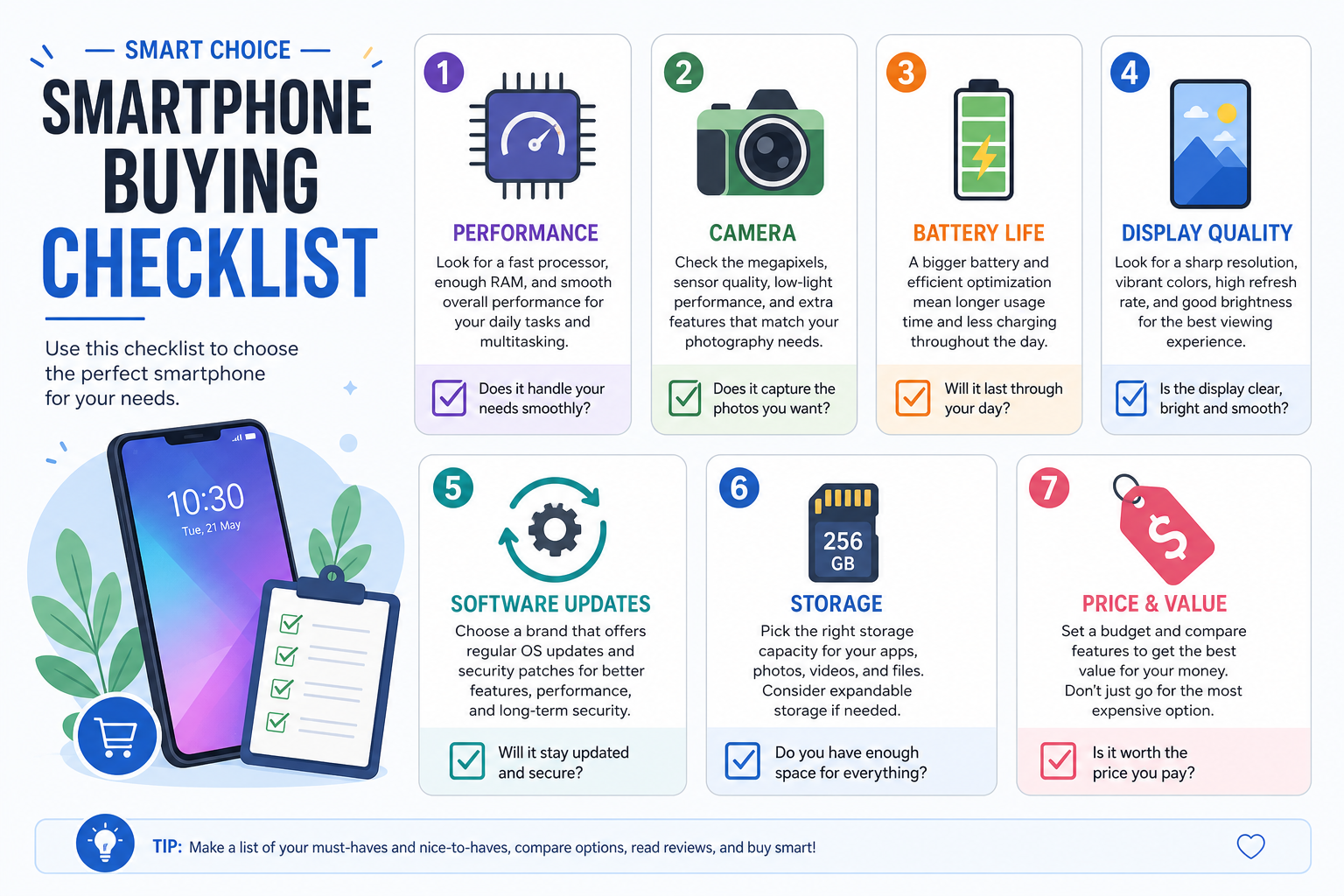
- 3 The 7 Core Factors in Any Good Phone Comparison
- 3.1 1. Performance: Don’t Judge by Processor Name Alone
- 3.2 2. Camera Quality: Compare the Main Camera, Not Just the Megapixels
- 3.3 3. Battery Life: Capacity Helps, Efficiency Decides
- 3.4 4. Display: One of the Most Important Daily Experience Factors
- 3.5 5. Software Experience: The Most Underrated Comparison Factor
- 3.6 6. Storage and RAM: Buy for the Next Two Years, Not Today
- 3.7 7. Price and Value: Compare Total Value, Not Just the Lowest Number
- 4 A Practical Phone Comparison Framework You Can Actually Use
- 5 Common Phone Comparison Mistakes to Avoid
- 6 Should You Compare Phones From the Same Brand or Across Brands?
- 7 Which Specs Matter Less Than Buyers Think?
- 8 How to Compare Phones by Budget
- 9 A Simple Buyer Checklist Before You Decide
- 10 Why a Good Comparison Platform Makes a Big Difference
- 11 Final Verdict
Why Phone Comparison Matters More Than Ever
Modern smartphones are better than ever, but they are also more confusing than ever. Even within the same brand, two phones can look similar on paper but feel very different in real life.
A useful phone comparison helps you avoid common mistakes like:
- paying flagship money for features you will never use
- choosing a camera phone that only performs well in daylight
- buying a powerful phone with poor battery optimisation
- ignoring software support and regretting it after two years
- selecting storage or RAM that does not match your usage
“A 2024 global survey indicated that 69% of respondents considered battery life very important when choosing their next smartphone.” – GSMA
That stat tells you something important: buyers do not just chase specs. They care about how a phone fits real life.
Start With Your Own Usage, Not the Marketing
Before comparing two or more phones, ask one question first:
What do you need the phone for?
Your answer changes everything.
Best priorities by user type
| User type | What matters most |
|---|---|
| Casual user | battery life, display quality, clean software, value |
| Student | price, durability, battery, decent camera |
| Gamer | processor, cooling, refresh rate, battery, charging |
| Content creator | main camera, selfie camera, video quality, storage |
| Business/professional | software reliability, updates, battery, call quality |
| Long-term buyer | software support, build quality, battery health, resale value |
A lot of competitor content stays too general here. The real gap is this: the best phone is not universal. The best phone is the one that matches your habits.
The 7 Core Factors in Any Good Phone Comparison
1. Performance: Don’t Judge by Processor Name Alone
Performance is about more than whether a phone opens apps quickly. It affects gaming, multitasking, camera processing, long-term smoothness, and heat management.
What to compare
- chipset generation
- CPU and GPU class
- RAM amount and type
- storage speed
- thermal management
- software optimisation
Real-world performance questions
Ask:
- Does the phone stay smooth after months of use?
- Can it handle gaming without overheating badly?
- Is multitasking reliable?
- Does camera processing feel quick?
- Does the UI feel polished or laggy?
A mid-range phone with good optimisation can feel better than a poorly tuned “powerful” phone.
Quick performance guide
| Need | Recommended level |
|---|---|
| Basic use | efficient mid-range chipset, 6GB RAM minimum |
| Heavy multitasking | strong mid-range or flagship chip, 8GB+ RAM |
| Gaming | upper mid-range or flagship chip, good cooling |
| Long-term use | newer chipset with solid software support |
2. Camera Quality: Compare the Main Camera, Not Just the Megapixels
One of the biggest mistakes in phone comparison is assuming higher megapixels mean better photos. They do not.
A 50MP or 200MP camera can still perform poorly if image processing, sensor quality, stabilisation, and low-light tuning are weak.
What actually matters in cameras
- sensor size
- image processing
- optical image stabilisation
- low-light performance
- dynamic range
- skin tones and colour consistency
- video stabilisation
- selfie camera quality
- ultrawide and telephoto usefulness
Camera comparison checklist
| Camera factor | Why it matters |
|---|---|
| Main sensor quality | affects detail, low-light, and dynamic range |
| OIS | helps night shots and stable video |
| Processing | controls colours, sharpness, HDR balance |
| Ultrawide quality | useful for travel and group shots |
| Telephoto lens | important for portraits and zoom |
| Video quality | matters for creators and reels |
Many phones advertise triple or quad cameras, but often only the main camera is truly good. When comparing phones, focus first on the main camera and video consistency.
3. Battery Life: Capacity Helps, Efficiency Decides
Battery life is one of the most practical parts of a phone comparison because it affects every user.
A bigger battery does not automatically mean longer endurance. Software tuning, display resolution, chipset efficiency, and background app management all matter.
What to compare for battery
- battery size in mAh
- chipset efficiency
- display refresh rate
- software power management
- charging speed
- charger included or not
- battery health reputation over time
General battery expectations
| Battery size | Typical expectation |
|---|---|
| 4,500mAh | decent for compact or efficient phones |
| 5,000mAh | standard sweet spot for most users |
| 5,500mAh+ | strong endurance, especially in mid-range phones |
Fast charging matters too
Battery life is only half the story. Charging speed changes user experience dramatically.
- 25W: acceptable
- 45W to 67W: very convenient
- 80W and above: excellent for power users
But faster charging is best when paired with good thermal control and long-term battery care.
4. Display: One of the Most Important Daily Experience Factors
You interact with the screen constantly, so display quality should never be treated as a minor spec.
Compare these display factors
- panel type: AMOLED vs LCD
- brightness
- refresh rate
- resolution
- colour accuracy
- touch responsiveness
- HDR support
- screen protection
AMOLED vs LCD
AMOLED usually offers:
- better contrast
- deeper blacks
- more premium look
- improved media viewing
LCD can still be fine on cheaper phones, but AMOLED usually wins for overall experience.
Refresh rate guide
| Refresh rate | Best for |
|---|---|
| 60Hz | basic users, budget phones |
| 90Hz | smoother everyday use |
| 120Hz | gaming, scrolling, premium experience |
A 120Hz panel sounds great, but brightness and tuning matter too. A bright, colour-accurate 90Hz display may feel better than a dim 120Hz one.
5. Software Experience: The Most Underrated Comparison Factor
This is where many comparison articles stay too shallow. Software is not just about Android version. It shapes how the phone feels every day.
What software comparison should include
- number of Android OS updates
- security patch duration
- bloatware level
- UI smoothness
- ads or spammy notifications
- useful features
- update speed
- long-term reliability
“Around 90% of consumers rated longer software and security updates as important factors in their next purchase decision.” – GSMA Mobile Net Zero 2025
That is a major buying signal. If you plan to keep a phone for 3 to 5 years, software support is not optional. It is a core value factor.
Why software support changes value
A slightly more expensive phone with 4 to 7 years of support may be a smarter buy than a cheaper one with weak updates. It will likely stay secure, hold resale value better, and feel modern for longer.
At Phoneranker, this is one of the most important areas we highlight because buyers often focus too much on launch-day specs and too little on ownership over time.
6. Storage and RAM: Buy for the Next Two Years, Not Today
A phone that feels adequate today can become frustrating quickly if you buy too little storage.
Storage recommendations
| Type of user | Recommended storage |
|---|---|
| Basic user | 128GB |
| Most users | 256GB |
| Heavy creator/gamer | 256GB to 512GB |
RAM recommendations
| Usage | Recommended RAM |
|---|---|
| Light everyday use | 6GB |
| Most users | 8GB |
| Heavy gaming/editing | 12GB or more |
If you take lots of photos, download videos, install large games, or keep phones for years, 256GB is usually the safer pick.
7. Price and Value: Compare Total Value, Not Just the Lowest Number
The cheapest phone is not always the best deal. A better phone comparison looks at value, not just price.
Value means asking
- What am I getting for the money?
- Which compromises actually matter to me?
- Is the extra cost improving camera, battery, display, or support in a meaningful way?
- Will this phone still feel good after two years?
Simple value framework
| Budget | What to expect |
|---|---|
| Entry-level | basic use, compromise in camera and display |
| Budget mid-range | best for value seekers |
| Upper mid-range | strong balance of features and price |
| Flagship | best cameras, best build, best performance, but diminishing returns |
For many buyers in India and similar price-sensitive markets, the upper mid-range is often the sweet spot.
A Practical Phone Comparison Framework You Can Actually Use
Instead of reading endless spec sheets, score each phone across key areas.
The 100-Point Comparison Method
| Category | Weight |
|---|---|
| Performance | 20 |
| Camera | 20 |
| Battery | 20 |
| Display | 15 |
| Software | 15 |
| Build/Design | 5 |
| Price/Value | 5 |
Then rate each phone honestly. This makes comparison clearer and reduces emotional buying.
Example Comparison Table
| Factor | Phone A | Phone B | Better choice |
|---|---|---|---|
| Performance | Strong flagship chip | Upper mid-range chip | Phone A |
| Camera | Better low light and video | Better selfies | Depends on use |
| Battery | 5,000mAh, 45W | 5,500mAh, 80W | Phone B |
| Display | Brighter AMOLED | Bigger AMOLED | Depends on preference |
| Software | 5 years updates | 3 years updates | Phone A |
| Price | Higher | Lower | Phone B |
| Overall value | Premium | Better value | Depends on budget |
This is the kind of balanced approach that helps users make smart decisions instead of chasing just one standout spec.
Common Phone Comparison Mistakes to Avoid
Choosing by megapixels alone
A better sensor and better tuning matter more than a higher number.
Ignoring software support
A cheaper phone with poor updates can become a bad deal fast.
Overpaying for performance you do not need
Not everyone needs flagship power.
Buying too little storage
128GB is fine for some users, but many people outgrow it quickly.
Ignoring ergonomics
A large phone may look impressive but feel uncomfortable daily.
Falling for launch hype
Wait for real-world reviews, camera samples, and battery impressions.
Should You Compare Phones From the Same Brand or Across Brands?
Both are useful.
Same-brand comparison
Helpful when deciding between, for example:
- Samsung Galaxy A vs Samsung Galaxy S
- OnePlus Nord vs OnePlus numbered series
- Xiaomi Redmi vs Xiaomi flagship models
You usually get cleaner comparison on software style and ecosystem.
Cross-brand comparison
Helpful when deciding between value tiers, such as:
- Samsung vs Motorola
- OnePlus vs iQOO
- Pixel vs Samsung
- Vivo vs Oppo
This usually reveals better value differences in charging, cameras, UI, and update policy.
Which Specs Matter Less Than Buyers Think?
Not every spec deserves equal weight.
Often overrated
- megapixel count alone
- camera count
- peak benchmark score without heat testing
- extremely fast charging without battery longevity discussion
- “AI features” with little daily usefulness
Often underrated
- software support
- haptics
- speaker quality
- thermal control
- call quality
- sunlight visibility
- vibration quality
- resale value
These “small” things often shape satisfaction more than flashy marketing specs.
How to Compare Phones by Budget
Under budget segment
Focus on:
- reliable battery life
- decent display
- clean software
- dependable main camera
- essential 5G bands if relevant in your market
Avoid expecting flagship camera or gaming performance.
Mid-range segment
This is where comparison matters most because phones are closely matched.
Prioritise:
- display quality
- software experience
- main camera consistency
- battery and charging balance
- long-term value
Premium and flagship segment
Here, tiny differences matter more.
Compare:
- low-light photography
- zoom quality
- video performance
- premium build
- update promise
- ecosystem benefits
- heat management under sustained load
A Simple Buyer Checklist Before You Decide
Use this checklist before buying any phone:
- Does it fit my budget comfortably?
- Does it match my main use case?
- Is the battery dependable?
- Is the camera good in the conditions I actually shoot in?
- Is the software clean and well-supported?
- Do I have enough storage for the next two years?
- Am I paying for features I will never use?
- Is this genuinely the best value in its segment?
If you cannot answer those clearly, you are not ready to buy yet.
Why a Good Comparison Platform Makes a Big Difference
A lot of buyers jump between brand pages, e-commerce listings, and random opinions. That often creates more confusion, not less.
A better approach is using a platform built around clarity and trust. That is where Phoneranker stands out. Instead of throwing technical jargon at readers, Phoneranker focuses on:
- accurate and trustworthy smartphone information
- simple explanations in easy language
- detailed side-by-side phone comparisons
- timely updates on launches, prices, and trends
- honest reviews and first-look coverage
- clear specs and performance insights for practical decisions
That combination matters because phone comparison is not just about data. It is about making that data useful.
Final Verdict
The best way to do a phone comparison is to stop looking for a universally “best” phone and start looking for the best phone for your needs. Performance, camera, battery, display, software, storage, and price all matter, but not equally for every buyer.
If you want a smarter buying process, compare phones in a practical order:
- define your usage
- set your budget
- shortlist models
- compare real strengths and trade-offs
- prioritise long-term value, not just launch hype
That is exactly the kind of decision-making Phoneranker is built to support. If you want accurate specs, honest comparisons, simple explanations, and timely updates that help you buy confidently, Phoneranker is the place to start your next smartphone search.
FAQ
1. How do I know which phone is best for me?
Start with your budget and main usage. If you care most about gaming, camera quality, battery life, or long-term software support, compare phones based on those priorities instead of choosing by brand or hype alone.
2. Which phone is best comparison?
The best phone comparison looks at performance, camera, battery, display, software, storage, and price together. A side-by-side comparison is most useful when it reflects real-world needs, not just raw specs.
3. Which series is better, S or A?
In general, Samsung’s S series is better for flagship performance, cameras, and premium features. The A series is better for value and can be the smarter buy if you want a more affordable phone with balanced features.
4. How to choose a best mobile phone?
Choose a phone by checking your budget, daily usage, battery needs, camera expectations, software support, and storage requirements. The best mobile phone is the one that fits your routine well for the next few years, not just the one with the biggest numbers.
5. Is the Samsung A or S better?
The Samsung S series is better overall in performance, cameras, and premium design. But if you want stronger value for money, the Samsung A series can be better for everyday users and budget-conscious buyers.
6. Which is better, a 128GB or 256GB phone?
For most people, 256GB is the safer long-term choice, especially if you take lots of photos, videos, or install large apps and games. 128GB is still fine for lighter users who mainly use cloud storage and do not keep large files on the phone.
Read More : vivo X300 FE is the Ultimate Compact Flagship? Ft. Snapdragon 8 Gen 5