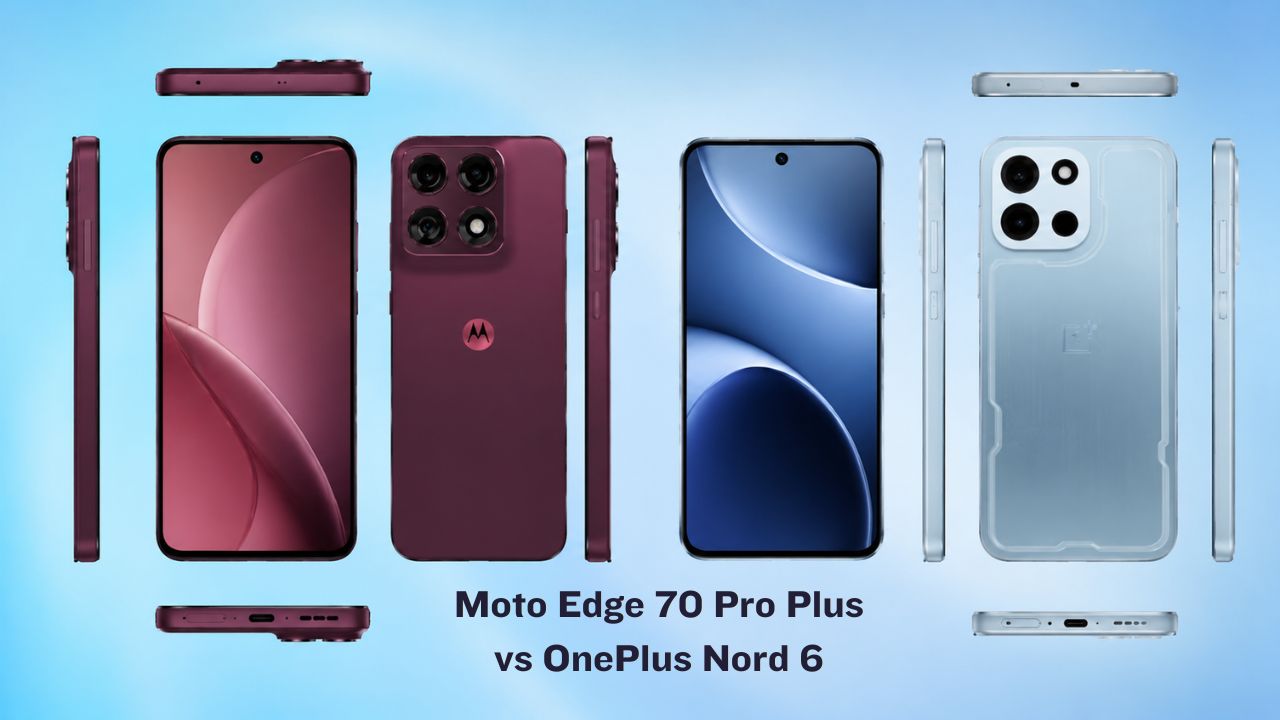
The premium smartphone segment has become highly competitive recently. Every brand is trying to offer flagship-level features at a aggressive price point. In this race, Motorola has made a strong statement with its new Motorola Edge 70 Pro Plus. Priced at an attractive discounted rate of Rs 44,999, this phone is creating a lot of buzz in the market.
However, Vivo is also ready with a tough reply in the form of the Vivo V70. Both these smartphones come with very competitive specifications, but they target different types of users. If you have a budget of around Rs 45,000 to Rs 50,000 and are confused between these two devices, this detailed comparison review will help you make the right choice.
Contents
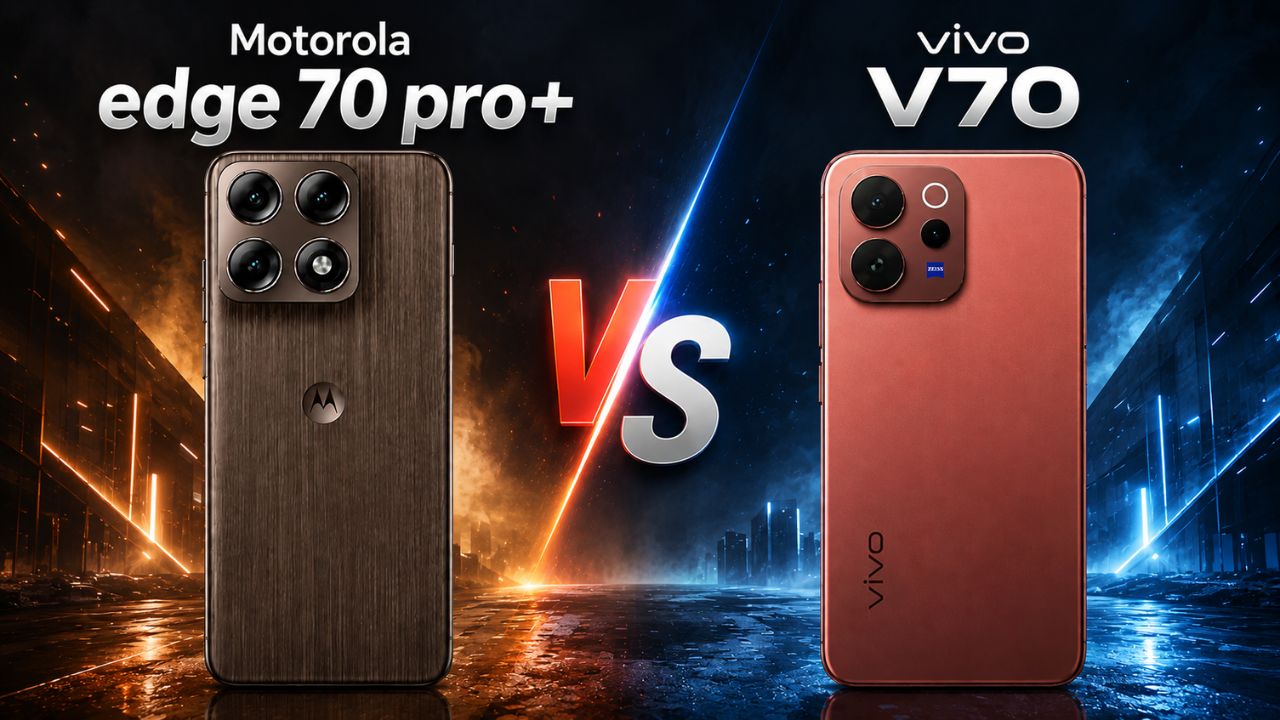
Motorola Edge 70 Pro+ vs vivo V70
Before diving deep into the detailed experience, let’s take a look at how these two premium devices stack up against each other on paper:
| Feature | Motorola Edge 70 Pro Plus | Vivo V70 |
| Display | 6.88-inch 1.5K 144Hz Quad-Curved AMOLED | 6.59-inch 1.5K 120Hz AMOLED |
| Processor | MediaTek Dimensity 8500 Xtreme | Qualcomm Snapdragon 7 Gen 4 |
| Rear Camera | 50MP (Sony Lytia 700) + 50MP Ultra-wide + 50MP (3.5x Periscope) | 50MP (Sony IMX 766) + 8MP Ultra-wide + 50MP (3x Telephoto) |
| Front Camera | 50MP Selfie | 50MP Selfie |
| Battery & Charging | 6,500 mAh, 90W Wired, 15W Wireless | 6,500 mAh, 90W Wired, No Wireless Charging |
| Durability | IP68 + IP69 + Military Grade 810H | IP68 + IP69 Rating |
| Biometrics | Optical In-display Scanner | Ultrasonic In-display Scanner |
| Software Support | 3 Years OS + 5 Years Security Updates | 4 Years OS + 6 Years Security Updates |
| Effective Price | Rs 44,999 (12GB + 256GB) | Rs 49,999 (12GB + 256GB) |
Design and In-Hand Feel
The first thing you notice about any smartphone is its design, and both brands have taken completely opposite directions here.
Motorola’s Personality-Driven Looks
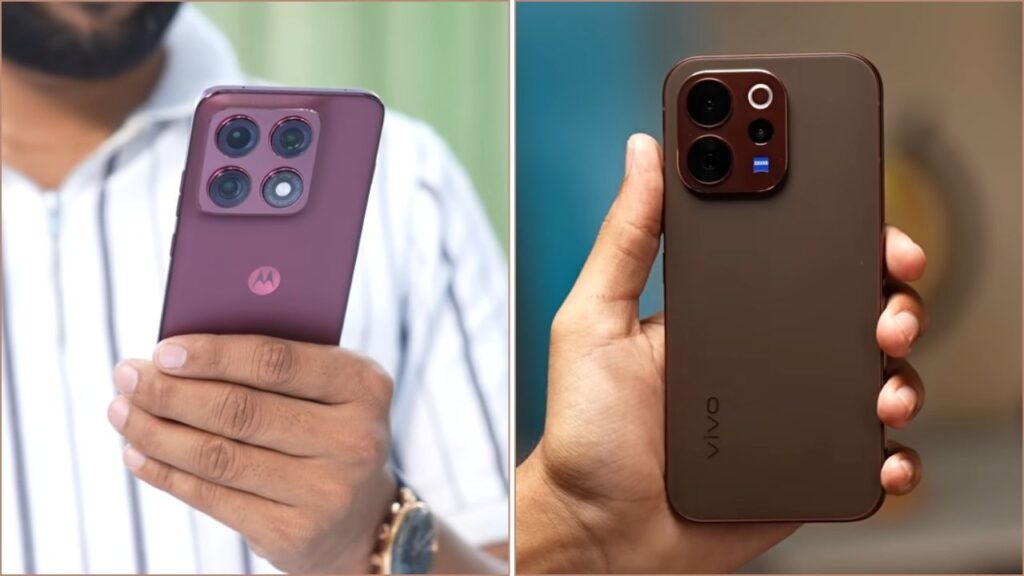
Motorola has focused heavily on making a style statement. The Edge 70 Pro Plus comes in three unique, Pantone-validated finishes. The Pantone Zinfandel variant comes with a soft satin-look finish that feels very premium.
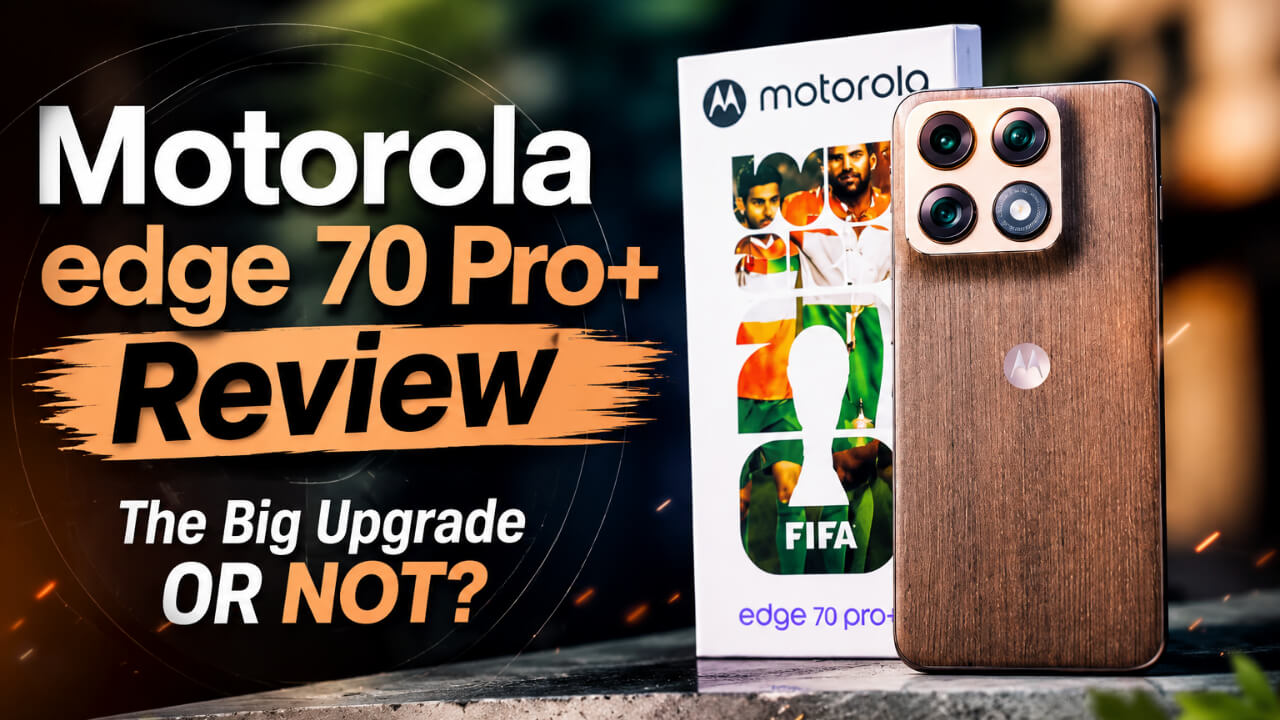
If you like a standout look, the Pantone Chicory Coffee variant offers a unique sculpted wooden finish. There is also a Pantone Stormy Sea color option which features a textured, twill-inspired pattern. To make it more premium, Motorola has used different accent colors for the camera rings on each variant.
It is incredibly slim at just 7.19 mm (7.34 mm for the wooden version) and feels very light in the hand as it weighs under 190 grams. Thanks to the quad-curved front display and curved back glass, the phone feels even thinner than it actually is.
Vivo’s Clean and Classy Approach
On the other side, the Vivo V70 follows a more traditional, classic glass-slab look. It features premium glass on the back and a solid metal frame on the sides.
This metal frame gives it a more premium, high-quality touch compared to the frame used on the Motorola phone. Vivo’s design is very clean, minimal, and understated. It feels very comfortable and balanced in daily use, targeting users who prefer simple luxury over flashy designs.
Build Quality and Durability
While both phones use Corning Gorilla Glass 7i on the front, we highly recommend using a good quality screen protector because this specific glass is more prone to minor scratches over time.
When it comes to toughness, Motorola wins clearly. Both devices come with excellent IP68 and IP69 ratings for water and dust resistance, meaning they can survive deep water immersion and high-pressure water jets.
However, Motorola goes a step further by including Military Standard 810H certification, making it much more capable of surviving accidental drops and harsh conditions.
Display and Audio
If you watch a lot of movies, web series, or YouTube videos, the quality of the screen and speakers becomes highly important.
Screen Comparison
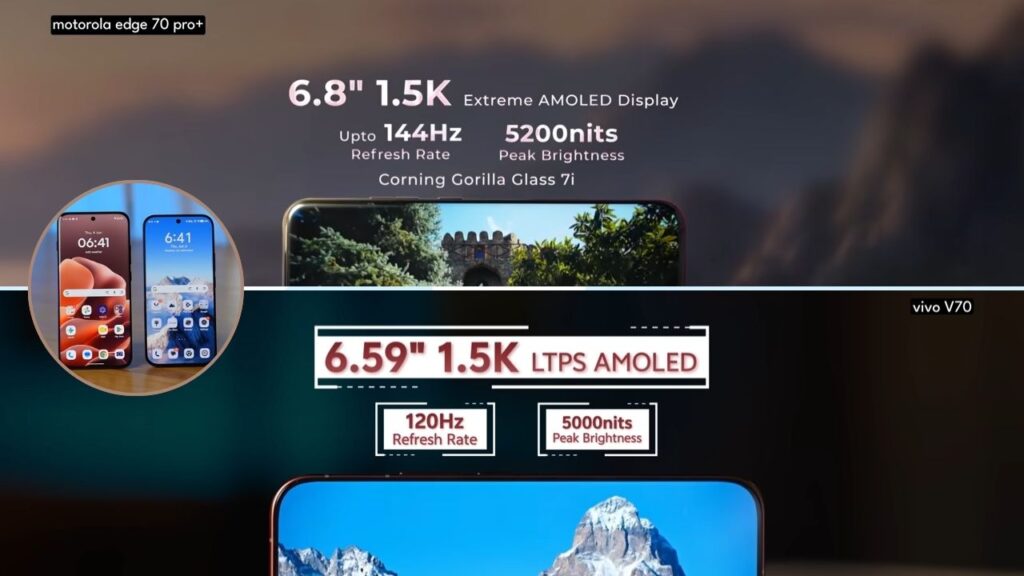
The Motorola Edge 70 Pro Plus comes with a massive 6.88-inch 1.5K quad-curved AMOLED display. It supports up to a 144Hz refresh rate, making animations feel buttery smooth. It also boasts a massive 5,200 nits of peak brightness, making it clearly more visible and brighter under harsh outdoor sunlight or while playing HDR videos.
The Vivo V70 features a slightly smaller, more compact 6.59-inch AMOLED display with a standard 120Hz refresh rate and 5,000 nits of peak brightness.
During side-by-side color testing, we noticed that Vivo shows slightly better, more accurate colors in standard menus.
However, when it comes to dynamic range and smooth color transitions in HDR videos on YouTube, Motorola takes the lead. Vivo fights back well by supporting Netflix HDR playback, a feature that is surprisingly missing on the Motorola device.
Audio, Haptics, and Biometrics
- Speakers: Motorola features dual stereo speakers with Dolby Atmos certification. The sound is loud, rich, and full of depth. In comparison, Vivo’s speakers sound a bit thin and quiet.
- Haptics: The vibration feedback (haptics) is much crisper and tighter on Motorola, thanks to its well-tuned X-axis linear motor.
- Fingerprint Sensor: Vivo takes a major win here by offering an advanced Ultrasonic in-display fingerprint scanner. Motorola uses a standard optical sensor. The ultrasonic scanner on the Vivo is noticeably faster, works even with wet fingers, and feels much more premium.
Performance and Gaming
This is where the difference between the two phones becomes very clear. Motorola completely outperforms Vivo in terms of processing power and raw speed.
The Hardware Setup
Both smartphones use fast LPDDR5X RAM and top-tier UFS 4.1 storage. However, Motorola gives you a massive 12GB RAM + 256GB storage configuration as standard, whereas Vivo also sells a lower 8GB RAM variant.
The real magic lies in the chipsets:
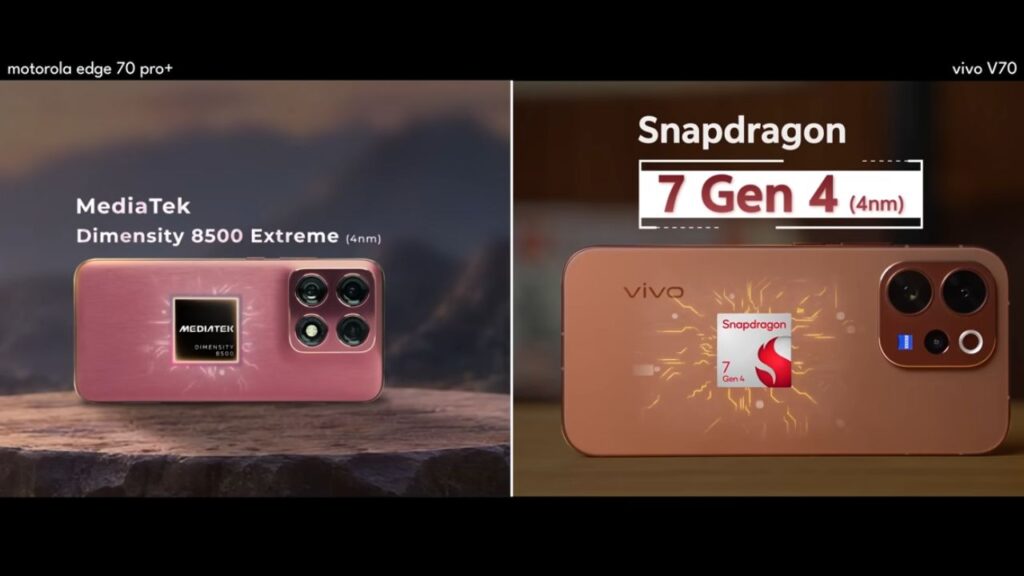
- Motorola Edge 70 Pro Plus: Powered by the flagship-grade MediaTek Dimensity 8500 Xtreme.
- Vivo V70: Powered by the mid-range Qualcomm Snapdragon 7 Gen 4.
Benchmark and Real-World Gaming Test
In synthetic benchmark tests like AnTuTu and Geekbench, Motorola scores significantly higher than Vivo. But benchmarks don’t tell the full story; real-world stability matters more.
During our heavy 30-minute CPU Throttling Test, Motorola maintained an impressive 75% stability because of its extra-large vapor cooling chamber. On the other hand, Vivo dropped down to 69% stability under heavy load.
When we played heavy games like Genshin Impact at the highest graphical settings and 60 frames per second (fps), the Motorola Edge 70 Pro Plus ran circles around the Vivo V70. It delivered much higher, more stable frame rates while running cooler at the same time. For gamers and power users, Motorola is the absolute winner.
Battery Life
Battery life is a strong point for both of these smartphones. Both brands have packed huge 6,500 mAh Silicon-Carbon batteries inside their devices. This new battery technology allows them to keep the phones incredibly slim while offering long battery backup.
In everyday real-world use, both phones perform similarly, giving roughly 6.5 to 7 hours of Screen-On Time (SOT) on a full charge. This means both can easily last a full day of heavy usage, or even up to two days under light usage.
When it comes to charging, both support 90W fast wired charging, allowing you to fill up the massive battery in less than an hour. However, Motorola takes the lead again by offering 15W wireless charging support, a convenient feature that Vivo has completely omitted from the V70.
Camera Performance: Megapixels vs Natural Tuning
On paper, both phones feature excellent triple-camera setups on the back, but their software processing and tuning philosophies are completely different.
Main and Zoom Lens Battle
Using the main 1x camera, both phones capture detailed pictures. However, Vivo tends to artificially sharpen fine details, while Motorola keeps the texture looking smooth and clean.
For portraits and zoomed shots:
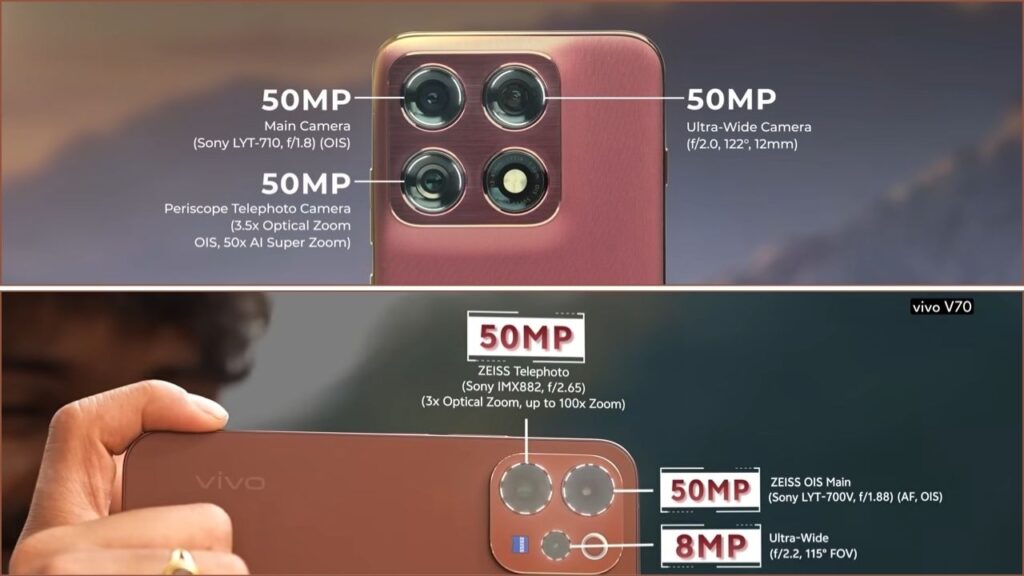
- At 3x zoom, Vivo captures sharper images because it has a dedicated 3x optical lens.
- At 3.5x zoom and above, Motorola’s 50MP Periscope lens takes over, delivering much better details and cleaner clarity up to 50x digital zoom.
Color Science and Portraits
If you like natural-looking photos, Vivo is the clear winner here. Thanks to its ZEISS Natural Color Mode, Vivo captures highly accurate skin tones and landscape colors. Motorola tends to artificially boost and brighten skin tones, which can sometimes make faces look unnatural.
Vivo also handles portrait backgrounds much better, offering beautiful background blur (bokeh drop-off) and edge detection, along with fun ZEISS lens simulation filters.
Ultra-wide, Low-Light, and Video Recording
- Ultra-wide: Motorola easily wins with its high-resolution 50MP ultra-wide sensor that supports autofocus for close-up macro shots. Vivo uses an outdated 8MP ultra-wide sensor which looks soft and lacks detail.
- Low-Light: Both phones tend to overprocess night shots, but Motorola’s night mode is slightly more aggressive with artificial brightening.
- Video Quality: Motorola dominates the video segment. It can record 4K videos at 60 fps across all three rear lenses and supports 4K 30 fps HDR10+ recording. Because of its low-resolution 8MP ultra-wide camera, Vivo is limited to just 1080p at 30 fps on its ultra-wide lens. Both phones support high-quality 4K 60 fps recording on their 50MP selfie cameras.
| Camera Feature | Motorola Edge 70 Pro Plus | Vivo V70 |
| Main (Primary) Camera | 50 MP (Sony Lytia 700 Sensor) • Clean, natural details without over-sharpening | 50 MP (Sony IMX 766 Sensor) • Good clarity, but tends to over-sharpen textures |
| Ultra-Wide Camera | 50 MP Sensor • High resolution, sharp images • Supports Autofocus for Macro (close-up) shots | 8 MP Sensor • Average resolution, softer details • No advanced macro features |
| Zoom (Telephoto) Lens | 50 MP Periscope Lens • 3.5x Optical Zoom • Better details at higher zoom levels (up to 50x AI Super Zoom) | 50 MP Telephoto Lens • 3x Optical Zoom • Slightly sharper details exactly at 3x magnification |
| Front (Selfie) Camera | 50 MP Sensor • Cleaner processing, natural skin tones | 50 MP Sensor • Excellent background separation, skin tones handle via ZEISS |
| Video Recording (Rear) | 4K @ 60 fps (Sabhi lenses par) • Supports 4K @ 30 fps HDR10+ video | 4K @ 60 fps (Main aur Zoom lens par) • Ultra-wide lens is restricted to 1080p @ 30 fps |
| Video Recording (Front) | 4K @ 60 fps | 4K @ 60 fps |
| Color Tuning & Portraits | Pantone Validated (Tends to boost skin tones slightly) | ZEISS Natural Color Mode (Highly accurate colors and beautiful portrait bokeh) |
Software and AI
Software is another area where personal preference plays a big role, but the current trends favor clean layouts and smart AI features.
Motorola’s Hello UI (Android 16)
Motorola runs on Hello UI, which offers a clean, close-to-stock Android experience. While it does come with a few pre-installed apps, you can easily uninstall almost all of them (except the Indus App Store). Motorola has optimized its software to reduce minor stutters, making the user interface feel fluid.
The phone shines with its Moto AI 2.0 features, which feel practical for daily use:
- Catch Me Up 2.0: Quickly summarizes all your missed notifications.
- Text to Sticker & Sketch to Image: Fun creative tools to generate custom graphics via text prompts.
- Moto Secure 5.0: Backed by ThinkShield enterprise-grade security to keep your personal data protected.
Vivo’s Origin OS 6 (Android 16)
The Vivo V70 runs on Origin OS 6. It is packed with customization options and unique elements like Origin Kit and Origin Island (dynamic notification pills). However, its overall layout feels a bit complicated compared to Motorola’s clean design.
Where Vivo takes a major lead is long-term software commitment. Vivo promises 4 years of major Android OS updates and 6 years of security patches, whereas Motorola only promises 3 years of OS updates and 5 years of security patches.
Final Verdict: Which Phone Offers Better Value?
Choosing between these two smartphones comes down to your budget and what features matter most to you.
Why You Should Choose the Motorola Edge 70 Pro Plus
At an effective discounted price of Rs 44,999 for the 12GB + 256GB variant, Motorola offers incredible value for money. You should buy it if you want:
- Superior gaming performance and a more powerful processor.
- A brighter, smoother 144Hz curved display.
- Much better ultra-wide camera quality and flagship-grade 4K 60fps video recording.
- The convenience of wireless charging and strong military-grade drop durability.
- A clean, bloatware-free software experience.
Why You Should Choose the Vivo V70
Priced higher at Rs 49,999 for the same storage configuration, the Vivo V70 is a bit expensive but holds its ground in specific areas. You should buy it if you want:
- Highly accurate colors, excellent portrait photography, and natural skin tones tuned by ZEISS.
- A fast, flagship-grade Ultrasonic in-display fingerprint sensor.
- An extra year of software updates (4 years of Android OS updates).
- A classic, understated design with a premium metal side frame.
Editor’s Choice: If we look at the overall balance of price and performance, the Motorola Edge 70 Pro Plus is our top recommendation. It saves you Rs 5,000 upfront while delivering better processing power, faster display specs, wireless charging, and more versatile video features. It stands out as the smarter, value-packed purchase in this premium segment.
Read More : Top 5 Best Mobile Phones Under ₹30000⚡Amazon & Flipkart Sale 2026