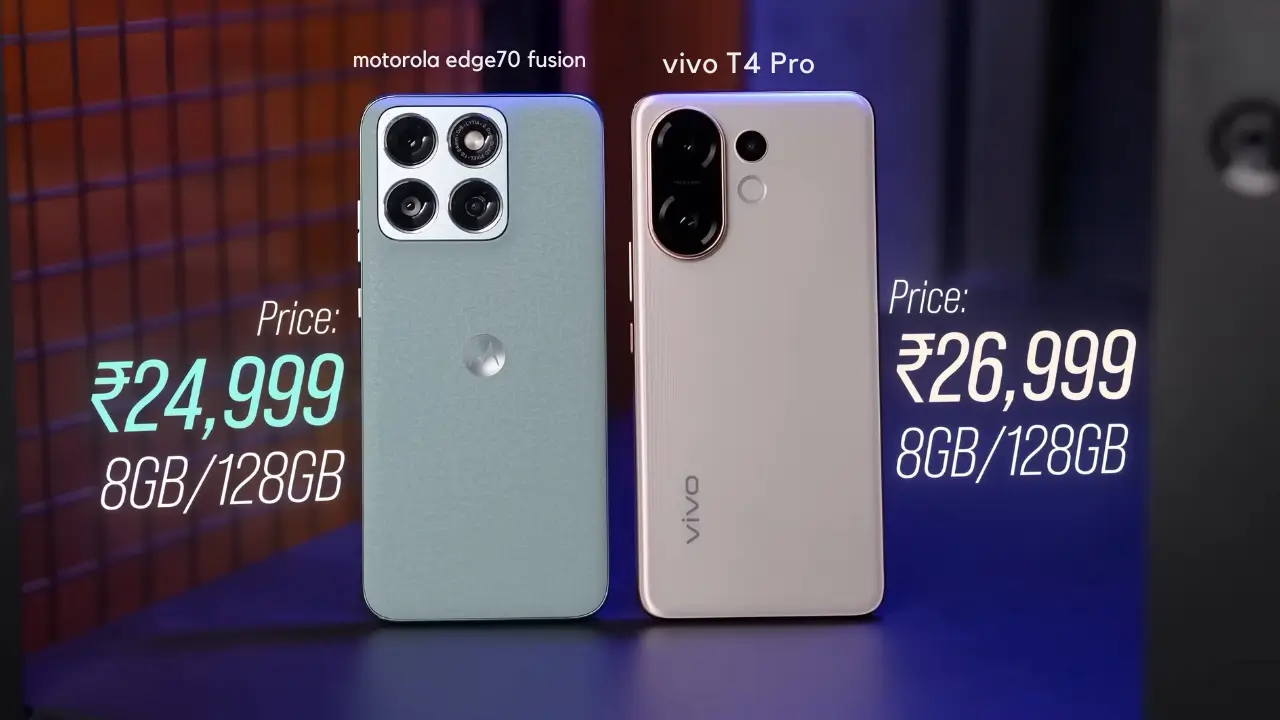
Motorola Edge 70 Fusion vs vivo T4 Pro : The smartphone landscape in 2026 has become a battlefield of incremental updates and “AI-first” marketing. However, every once in a while, a comparison emerges that genuinely challenges our understanding of value versus raw power. Today, we are looking at two heavyweights that have captured the market’s attention: the newly launched Motorola Edge 70 Fusion and the reigning veteran from last year, the vivo T4 Pro.
On paper, this looks like a classic David vs. Goliath match. Motorola is playing the “disruptor” card, offering a 2026 device that seemingly has no compromises at a lower price point. Meanwhile, vivo relies on its established premium hardware and a robust service network. But as any seasoned tech enthusiast knows, specifications are only half the story.
Contents
Design: Elegance vs. Classic
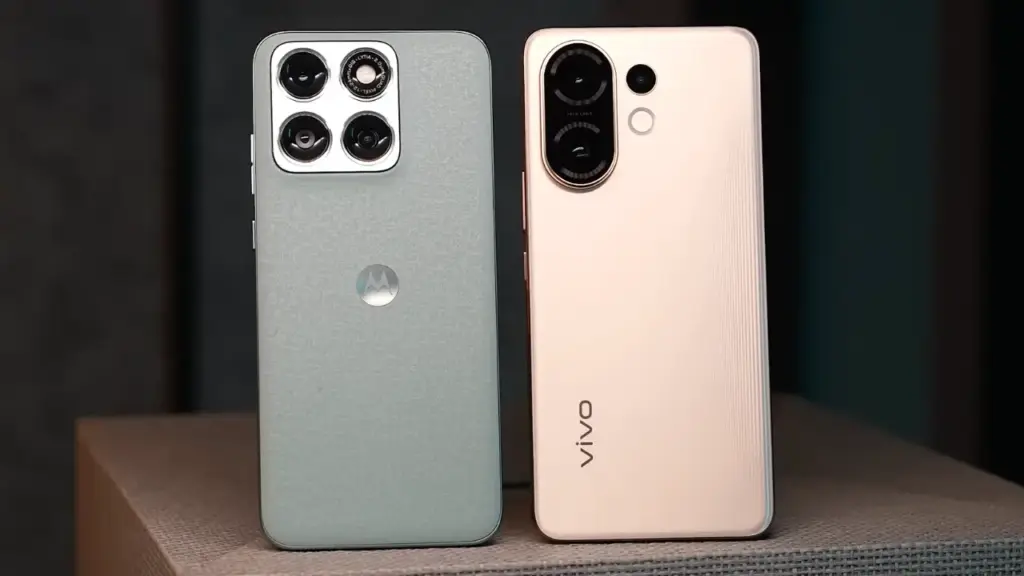
When you hold these two devices, the difference in philosophy is immediate. Motorola has doubled down on its “Edge” identity. The Edge 70 Fusion feels like a piece of high-end fashion. It moves away from the tired glass-and-plastic sandwich and introduces fabric-inspired finishes like Pantone Blue Surf and Country Air. These aren’t just names; the texture provides a tactile grip that makes the phone feel secure and premium without needing a bulky case.
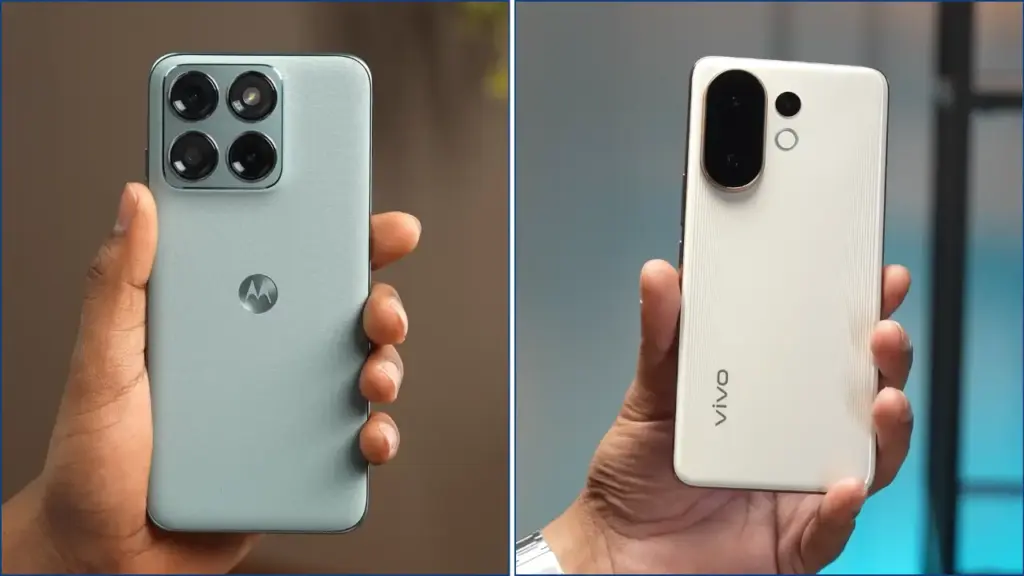
The vivo T4 Pro, on the other hand, borrows its design language from the more expensive X200 FE. It features a clean, circular camera island that looks professional. However, the back is high-quality plastic. While it’s durable, it lacks the “wow” factor and the sophisticated hand-feel of the Motorola’s textured finish.
Key Design Highlights:
- Durability: Both phones are surprisingly rugged, boasting IP68/IP69 ratings and Military Standard 810H certification.
- Protection: Motorola uses Corning Gorilla Glass 7i, giving it a slight edge over vivo’s Diamond Shield Glass.
- Ergonomics: Despite both having massive batteries, they remain slim. Motorola’s curved edges and textured back make it the more comfortable “one-handed” device.
Display
The display is where you spend 100% of your time, and both brands have taken different paths here.
Motorola offers a 6.78-inch 1.5K AMOLED panel with a blistering 144Hz refresh rate. It’s also Pantone validated, meaning the colors you see are professionally calibrated to be as natural as possible. The bezels are incredibly slim, providing an immersive “all-screen” feel that vivo can’t quite match.
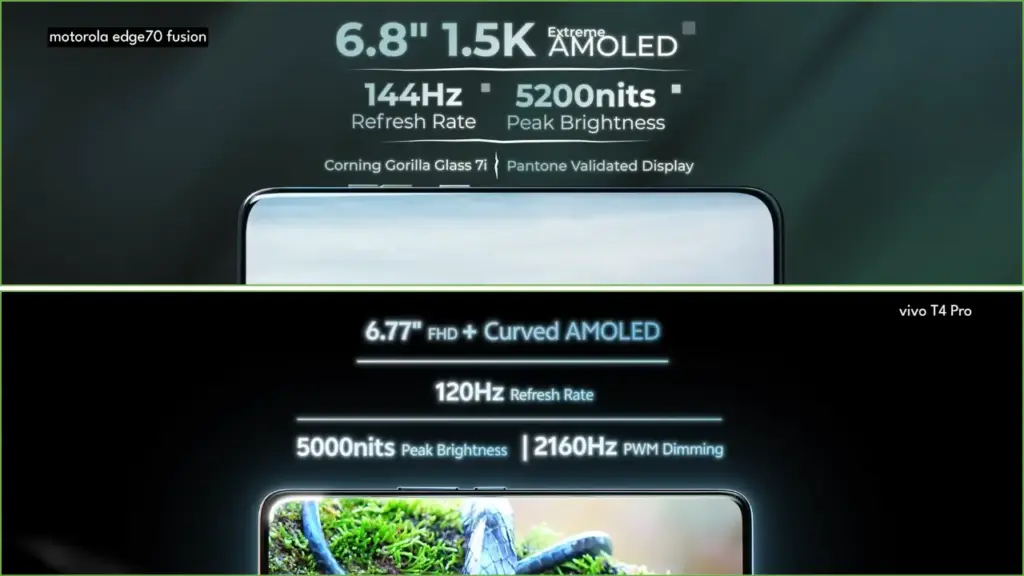
The vivo T4 Pro sticks to a 6.77-inch Full HD+ 120Hz panel. While it falls slightly behind in resolution and refresh rate, it strikes back with sheer brightness. In direct sunlight, the vivo panel is visibly easier to read. Furthermore, vivo offers better HDR tuning, supporting HDR content on both Netflix and YouTube, whereas Motorola is currently limited to YouTube.
If you are a cinephile who watches a lot of HDR content, vivo takes the lead. But if you value smoothness, resolution, and color accuracy for editing or browsing, Motorola’s 1.5K 144Hz screen is the superior window to your digital world.
Performance and Battery
This is where the comparison takes a shocking turn. On paper, the vivo T4 Pro should win. It houses the Snapdragon 7 Gen 4, which is technically a tier above the Snapdragon 7s Gen 4 found in the Motorola.
However, real-world testing tells a different story. Motorola has paired its chip with LPDDR5X RAM and UFS 3.1 storage, whereas vivo strangely opted for the older LPDDR4X and UFS 2.2. This faster memory pipeline in the Motorola closes the gap significantly.
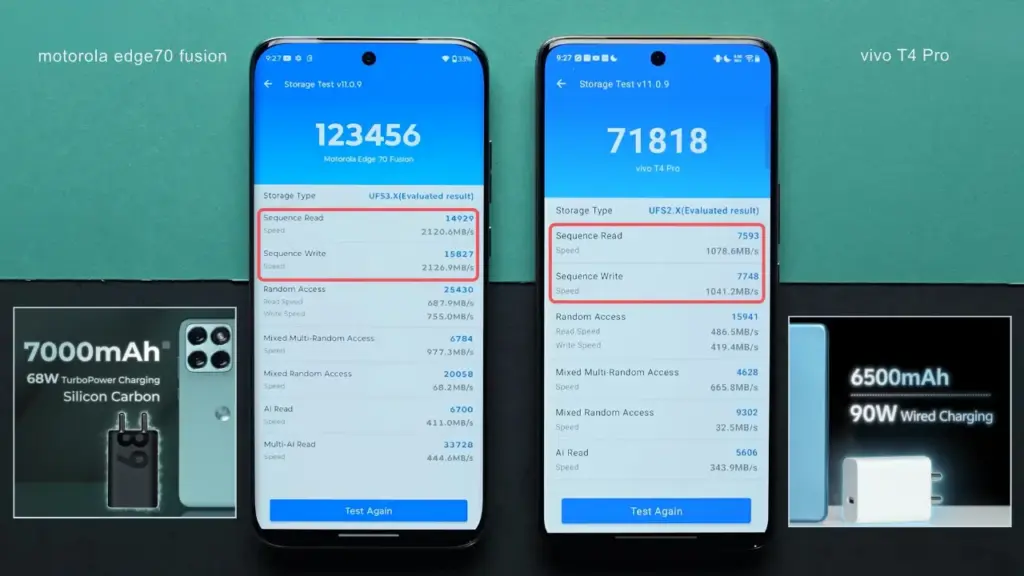
In our 30-minute Genshin Impact test one of the most demanding mobile games the Motorola Edge 70 Fusion actually maintained a higher average FPS and ran cooler than the vivo. This suggests that Motorola’s optimization and faster storage are doing heavy lifting that the vivo’s raw CPU power can’t overcome.
Battery Life & Charging:
- Motorola: A massive 7,000 mAh battery with 68W charging.
- vivo: A 6,500 mAh battery with 90W charging.
While vivo charges faster (0-100% in 55 minutes vs. Motorola’s 65+ minutes), the Motorola simply lasts longer. In a world where we are constantly on the move, that extra 500 mAh paired with a more efficient chip makes the Edge 70 Fusion a multi-day battery king.
Camera
The camera comparison highlights two very different ideologies:
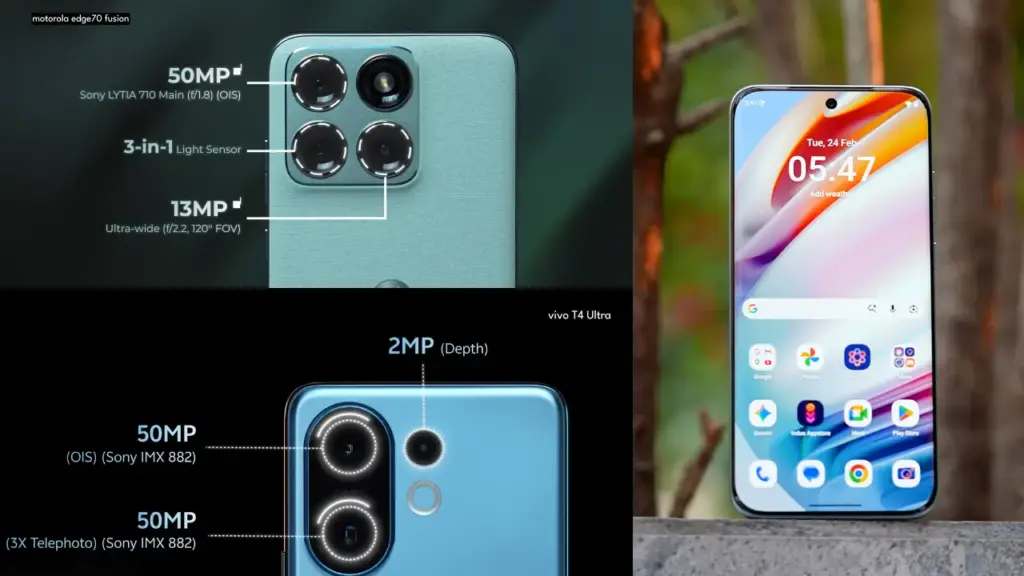
- Motorola’s Approach: Focus on the primary sensor and versatility. It features the world’s first Sony Lytia 710 sensor. This sensor is a beast in low light, capturing significantly more detail and brighter images than vivo’s IMX 882. It also uses its 13MP Ultra-wide lens to double as a high-quality Macro camera.
- vivo’s Approach: Focus on portraits and zoom. The T4 Pro includes a Periscope 3x optical zoom lens. If you take a lot of photos from a distance or love that compressed portrait look, vivo is the undisputed winner.
For daily photography snapping shots of food, friends, and evening landscapes Motorola’s primary sensor is more reliable. However, for travelers and social media enthusiasts who need that “Pro” zoom and superior selfie processing, vivo remains the gold standard in this segment.
Software
Software is often the “make or break” point for users.
- Motorola (Hello UI): It’s clean, near-stock, and now packed with useful AI. Features like Smart Connect (for PC integration) and Moto AI (image studio and Perplexity integration) feel like genuine tools rather than gimmicks. The lack of bloatware makes the phone feel “light” and responsive.
- vivo (Origin OS): It’s feature-rich and has arguably smoother animations. The “Origin Island” is a fun, functional addition. However, it still struggles with pre-installed apps and “Hot Apps” notifications that require a bit of manual cleaning during setup.
Motorola has also addressed the elephant in the room: Service. They have introduced nationwide service camps and free pickup-and-drop for the Edge series, closing the gap with vivo’s massive offline service network.
Conclusion: Which One is the “Smarter” Choice?
After an exhaustive comparison, the choice boils down to what you value in a daily companion.
The vivo T4 Pro is a specialist. It is the phone for the “Zoomer” the user who wants a periscope lens, faster charging, and a display that hits peak brightness for outdoor HDR viewing. It is a proven, reliable workhorse.
However, the Motorola Edge 70 Fusion feels like the more complete “2026” package. It defies the spec sheet by offering better gaming thermal management, a much larger battery, a more premium-feeling design, and a cleaner software experience all while being more affordable.
Final Verdict: If you want the best “all-rounder” that feels premium and lasts forever on a single charge, the Motorola Edge 70 Fusion is the smarter choice for most users. If you specifically need 3x optical zoom and a robust offline service presence, the vivo T4 Pro remains a solid alternative.
Read More : Motorola Edge 70 Fusion Launched in India With Snapdragon 7s Gen 4 and Massive 7000mAh Battery