Dimensity 9500s vs Snapdragon 8 Gen 5 : In the Indian market, there is a very famous logic: “Value for Money is King.” To understand the current state of the smartphone processor war, we can look at a simple example of Lotus Biscoff biscuits. Earlier, a 250g packet cost nearly ₹500 because it was imported. Today, since it’s made locally, you can grab it for ₹100. The product is still premium, but the price is now “Indian.”
The tech world is witnessing a similar shift. Chipset giants MediaTek and Qualcomm have realized that not everyone wants to spend one lakh rupees on a phone, but everyone wants flagship speed. This has led to the birth of “Flagship Killer” chips like the Dimensity 9500s (found in the Poco X8 Pro Max) and the Snapdragon 8 Gen 5 (powering the OnePlus 15R).
After rigorous testing, the results are in, and honestly? It’s a neck-and-neck battle where picking a winner is harder than ever.
Contents
CPU Architecture
When we go under the hood, both processors use an 8-core CPU setup, but their internal “blueprints” are different.
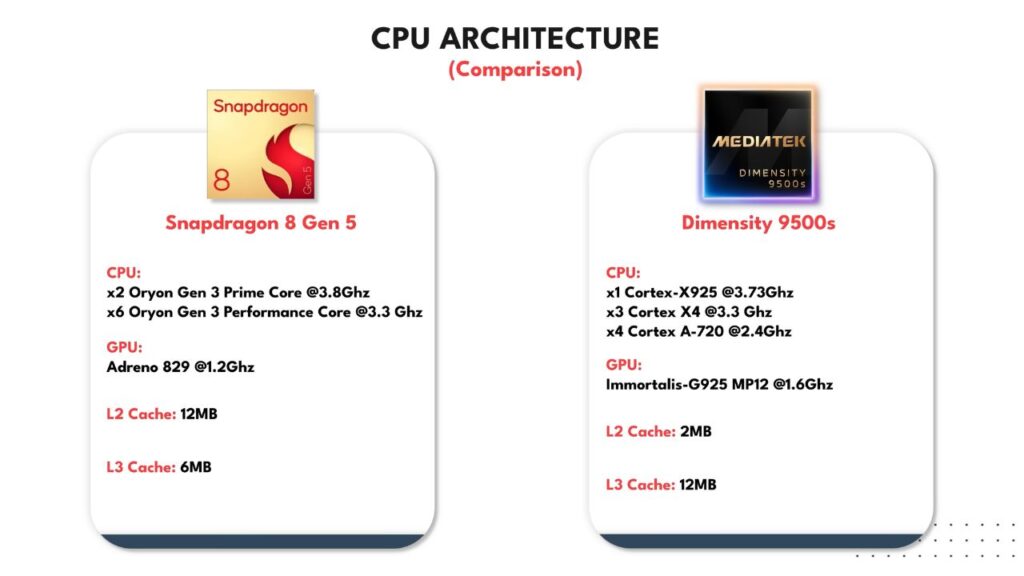
- Snapdragon 8 Gen 5: It follows a 2 + 6 configuration. It features two high-performance prime cores and six performance cores. The prime core here has a significantly higher clock speed, which makes it feel incredibly snappy during heavy tasks.
- Dimensity 9500s: This chip uses a more traditional 1 + 3 + 4 structure. It has one prime core, three performance cores, and four efficiency cores. While its clock speeds are slightly lower than Qualcomm’s, it manages power distribution very effectively.
Interestingly, while Qualcomm wins on CPU raw speed, MediaTek strikes back with its Immortalis MP12 GPU. The GPU in the Dimensity chip actually has a higher peak clock speed than the Adreno 829 found in the Snapdragon. However, Qualcomm counters this with a larger L2 Cache, which helps in faster data retrieval.
Synthetic Benchmarks
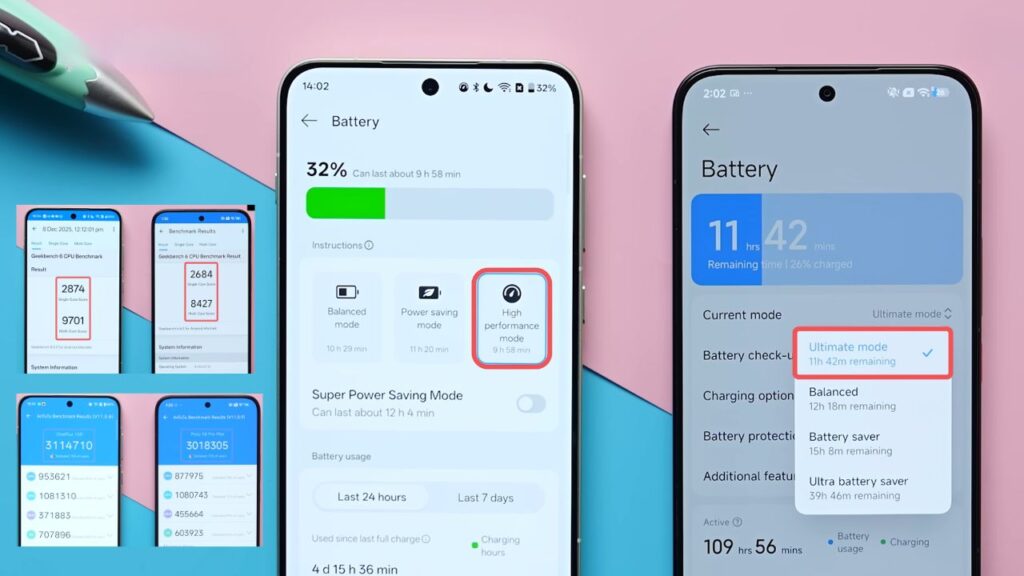
In the world of tech, numbers often tell half the story. We tested both devices the OnePlus 15R and Poco X8 Pro Max in their respective “Performance Modes” to see who draws first blood.
AnTuTu and Geekbench
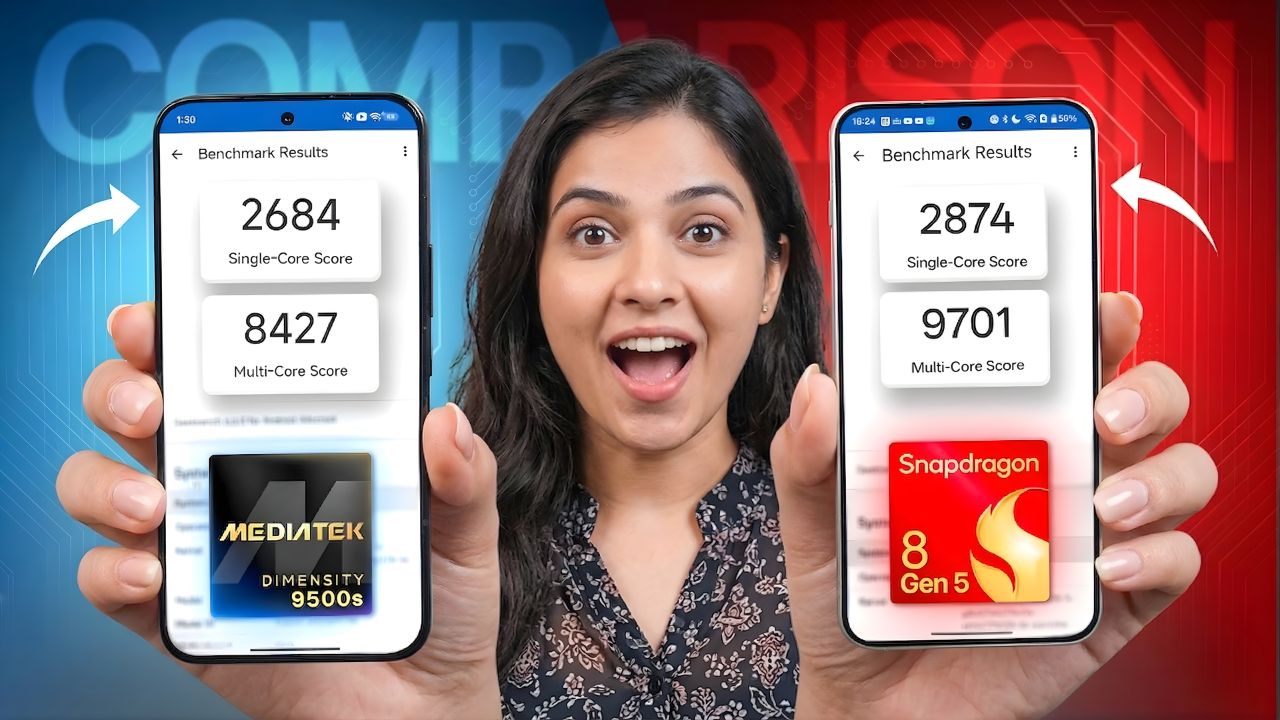
In terms of pure CPU power, Snapdragon 8 Gen 5 takes the lead. In AnTuTu and Geekbench (Single-core and Multi-core), the OnePlus 15R consistently scored higher than the Poco. However, the gap isn’t massive. It’s not a “blowout” victory; it’s more like winning a race by a few milliseconds.
GPU Benchmarks (3DMark)
This is where the tables turn. In the 3DMark Wild Life Extreme Stress Test, the Dimensity 9500s showed its muscle. It delivered a higher “Best Loop Score” and maintained better frames per second (FPS). Even in modern tests like Solar Bay and Steel Nomad Light, the MediaTek chip outperformed the Snapdragon, proving that its GPU is technically more capable on paper.
| Feature | Snapdragon 8 Gen 5 (OnePlus 15R) | Dimensity 9500s (Poco X8 Pro Max) |
| CPU Config | 2 + 6 Cores | 1 + 3 + 4 Cores |
| GPU | Adreno 829 | Immortalis MP12 |
| AnTuTu Lead | Yes | No |
| GPU Peak Performance | High | Higher |
| Stability | Excellent | Good |
Gaming Real-World Performance
Benchmarks are great for bragging rights, but gaming is where the “real” test happens. We tested three major titles: Genshin Impact, Wuthering Waves, and the highly demanding Arknights Endfield.
The Optimization Factor
In Genshin Impact and Wuthering Waves, the Snapdragon 8 Gen 5 surprisingly took the lead. It provided a higher average FPS and, more importantly, the OnePlus 15R ran a few degrees cooler. Even though both phones used “Frame Interpolation” to hit 120 FPS, the Snapdragon felt more stable.
The Raw Power Reveal
However, when we switched to Arknights Endfield which is a total resource hog the Dimensity 9500s finally flexed its muscles. It delivered a higher average FPS than the Snapdragon.
Why the difference? It comes down to Software Tuning. OnePlus has spent years optimizing their software for gaming performance. MediaTek’s chip has more “headroom” (potential power), but the way the phone manufacturer (Poco/Xiaomi) tunes the software determines how much of power is actually used.
The Verdict: Which One Should You Buy?
After days of testing, we realized we don’t have a single “Universal Winner.” Instead, we have two champions for different types of users.
- Choose Snapdragon 8 Gen 5 (OnePlus 15R) if: You want a balanced experience, better software optimization, and a phone that stays slightly cooler during long sessions of popular games like Genshin Impact. It is the “refined” choice.
- Choose Dimensity 9500s (Poco X8 Pro Max) if: You want raw GPU power and a chip that can handle future, more intensive games with ease. It is the “brute force” choice for gamers who care about peak frames.
Summary
In short, the Snapdragon 8 Gen 5 wins the CPU battle, while the Dimensity 9500s wins the GPU war. Both chips have successfully brought flagship-level performance down to a much more affordable price point, making the “Flagship Killer” segment more exciting than ever before.
Read More : Xiaomi 17 Ultra launched in India for Rs. 1,39,999